
How to Turn Your Study Materials Into an AI Learning Podcast
Students already have the raw material for better review sessions: lecture notes, PDFs, slide decks, reading summaries, practice explanations, and recorded lessons. The challenge is not access to content. It is finding more usable moments to revisit it without adding another hour of screen time.
That is where an AI learning podcast can help. Instead of letting your materials sit inside folders, you can transform them into structured audio for commutes, walks, workouts, chores, or low-focus review blocks. Done well, this turns passive time into reinforcement time. Done poorly, it becomes background noise.
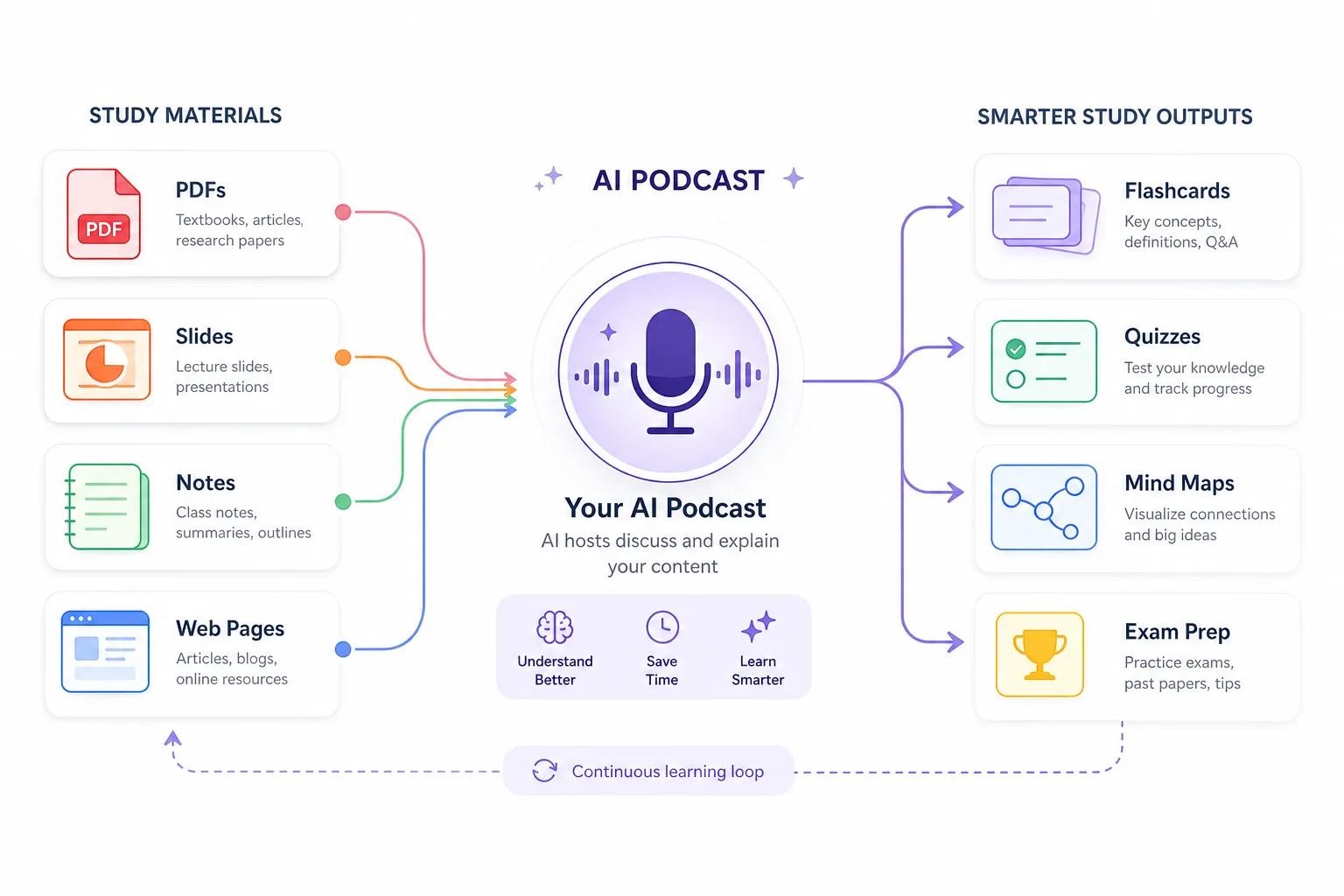
The real opportunity is not just using an AI podcast generator. It is building a study workflow where audio supports active learning rather than pretending to replace it. At CramAI, we see this as part of a broader system: upload your source materials, generate a personalized study path, identify knowledge gaps, and then repurpose the highest-priority concepts into audio, quizzes, flashcards, notes, and source-linked review.
"49% of U.S. adults listened to a podcast in the past year, and 88% of these listeners said learning was a reason they tuned in." - Pew Research Center
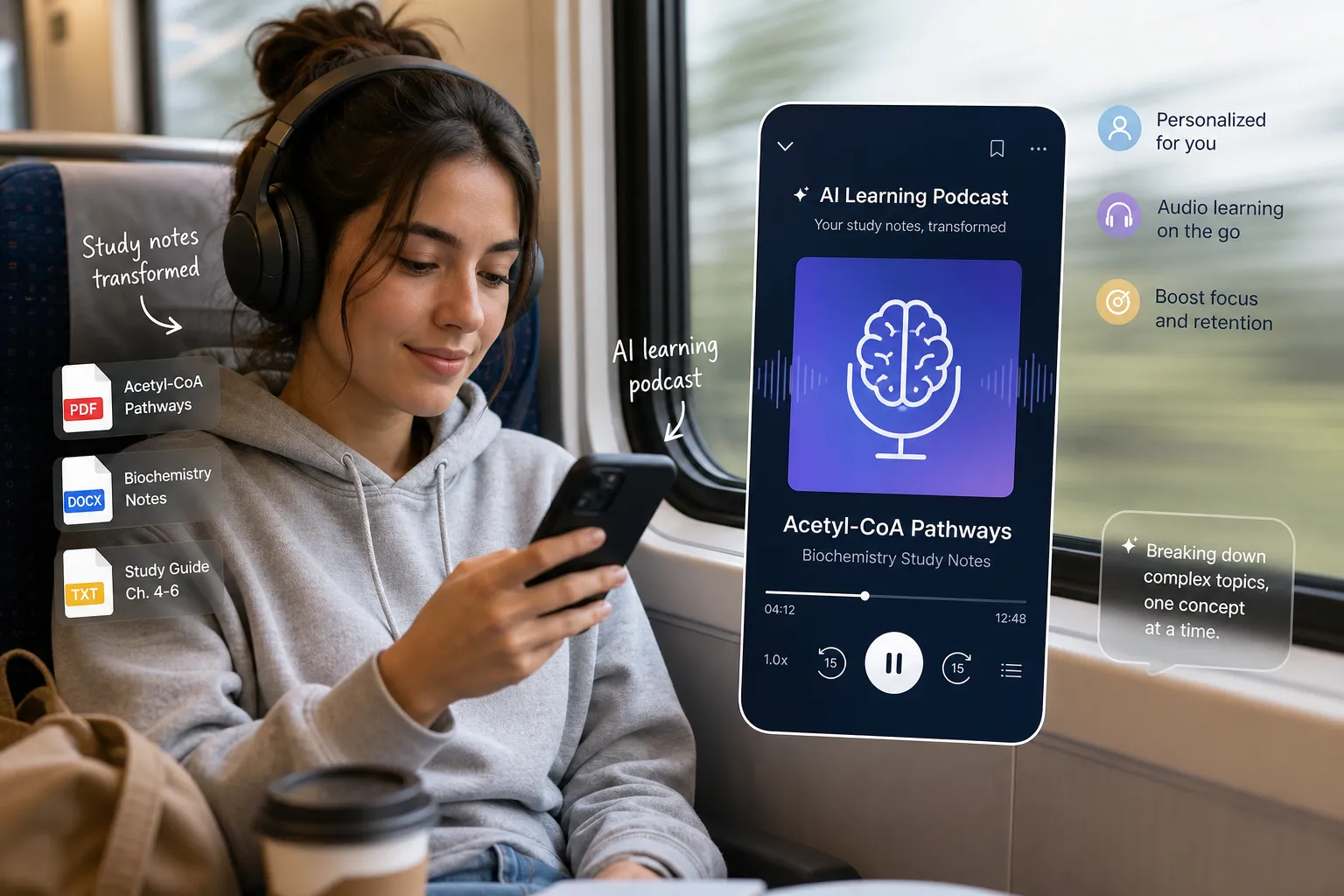
What an AI Study Podcast Actually Is
A study podcast is not just text read aloud. The best versions reorganize your content into an audio format that is easier to follow and remember.
That can include:
short chapter recaps
concept walkthroughs
question-and-answer reviews
two-speaker discussions
theory comparisons
final exam revision episodes
In other words, notes to podcast works best when the source material is curated, the objective is clear, and the output matches the learning task.
For example:
Study Need | Better Audio Format | Why It Works |
|---|---|---|
Reviewing a chapter fast | Concise chapter summary | Reduces overload and highlights essentials |
Understanding relationships between ideas | Discussion between two speakers | Makes contrasts and connections easier to hear |
Preparing for recall-heavy exams | Q&A review | Encourages mental retrieval while listening |
Clarifying one difficult topic | Concept explanation | Keeps attention on one problem at a time |
Last-week exam prep | Final revision episode | Helps consolidate the highest-yield material |
Comparing related theories | Side-by-side comparison | Improves discrimination between similar concepts |
Why Students Are Converting Notes, PDFs, and Slides Into Audio
There is a practical reason this approach is growing: many learners have unused low-focus time, but not enough uninterrupted desk time.
A PDF to podcast or slide-to-audio workflow helps when you want to:
review on a train or bus
revisit lecture content while walking
reinforce concepts during chores
reduce visual fatigue after long reading sessions
hear ideas explained in a more conversational way
The strongest use case is reinforcement, not first exposure. If a concept is brand new, dense, mathematical, or diagram-heavy, audio alone usually is not enough.
What Competitor Tools Get Right and What They Miss
Across leading tools and articles, a few themes repeat:
upload source materials from multiple formats
generate natural-sounding audio quickly
use podcasts for accessibility and convenience
position audio as useful for students on the go
Those are valid benefits. But several gaps remain.
Content gaps most articles gloss over
1. Audio is helpful, but passive listening has limits
Many pages imply that listening equals learning. It does not. Audio can improve exposure and review, but retention still depends on recall, practice, explanation, and correction.
"Retrieval practice consistently benefits student learning." - Educational Psychology Review
That matters because students often overestimate familiarity. If you listen to an episode and think, “Yes, that sounds familiar,” you may still be unable to answer a short-answer question or solve a problem.
2. Source quality matters more than voice quality
A realistic voice does not fix weak input. If you upload cluttered slides, fragmented notes, and an unfocused article mix, the output may sound polished while still being confusing.
3. Not every topic should become a podcast
Some material belongs in audio. Some belongs in flashcards. Some needs worked solutions, diagrams, or timed practice exams.
4. The best workflow is multimodal
Most tools pitch podcast creation as the destination. In reality, it should be one layer of a stronger study stack. CramAI is especially useful here because the same uploaded materials can support source-anchored answers, dynamic assessments, personalized plans, connected topic maps, and creator workflows in addition to audio review.
Which Study Materials Work Best for Podcast Conversion
Not every file type produces equally useful audio. Here is a realistic ranking.
Material Type | Works Well for Audio? | Best Use |
|---|---|---|
Clean lecture summaries | Excellent | Chapter recap or revision episode |
Text-heavy PDFs | Very good | Structured summaries and concept explanations |
Reading notes | Very good | Q&A review and memory reinforcement |
Slide decks with speaker notes | Good | Lecture recap if context is clear |
Research papers | Moderate | Best after extracting key findings first |
Formula sheets | Limited | Good as quick reminders, not full learning |
Diagrams-heavy subjects | Limited | Pair with visuals, notes, or mind maps |
Problem sets | Limited alone | Better for worked-strategy discussion than full solution learning |
Best candidates for turning into audio
your own chapter summaries
condensed lecture notes
textbook review outlines
revision sheets
reading takeaways
topic comparisons you already understand at a basic level
Materials that need cleanup first
scanned PDFs with poor formatting
image-heavy slides without explanation
mixed-topic folders
raw copied text with repetition
unfinished class notes
A Simple Workflow: From Uploaded Materials to Study Podcast
Here is the most effective sequence for turning learning materials into personalized audio.
1. Pick one narrow objective
Do not dump an entire course into one episode. Choose a target such as:
“Summarize Chapter 4 for tomorrow’s seminar”
“Compare classical conditioning and operant conditioning”
“Review the top 20 accounting ratios before the mock exam”
“Explain glycolysis at a beginner level”
2. Curate the source materials
Select only the most relevant inputs. Good inputs create good outputs.
This may include:
one PDF chapter
one slide deck
your own note summary
a class handout
one video transcript or article
3. Decide the right audio format
The format should match the cognitive task.
Concise chapter summary
Best for broad reinforcement and pre-class refreshers.
Discussion between two speakers
Useful when you want ideas contrasted, challenged, or linked naturally.
Question-and-answer review
Ideal for recall-based review and self-testing during listening.
Concept explanation
Strong for difficult ideas that need a clean verbal walkthrough.
Final exam revision episode
Best for high-yield recap near assessment time.
Comparison episode
Excellent for theories, cases, models, periods, or similar definitions students often confuse.
4. Keep it short enough to replay
For most students, 5 to 12 minutes is the sweet spot for focused repetition. Longer is not always better. A replayable 8-minute episode often beats a one-time 28-minute one.
5. Pair listening with one active task
After listening, do one of these:
write a 5-point summary from memory
answer 3 self-test questions
create 5 flashcards
explain the concept aloud
solve 2 related problems
mark unclear points for deeper review
This is where tools like CramAI become more powerful than standalone audio generators. You can move from listening into adaptive quizzes, source-linked explanations, knowledge maps, and updated study plans without rebuilding your materials from scratch.
Six Podcast Formats That Work Especially Well for Learners
1. The concise chapter summary
This is the most practical starting point. Convert one reading or lecture topic into a tightly organized recap with key definitions, arguments, and takeaways.
Use it when:
you need fast reinforcement
you are reviewing before class
you want an overview before deeper study
2. The two-speaker discussion
A dialogue can make dense material easier to follow. One speaker introduces the idea, while the other challenges, clarifies, or applies it.
Use it when:
the topic has debate or nuance
you are comparing viewpoints
you want content to feel more engaging
3. The question-and-answer review
This format helps convert passive listening into active anticipation. Even if the podcast asks the question, pause before the answer and try to retrieve it yourself.
Use it when:
you are studying for vocabulary-heavy or theory-heavy exams
you want to build quick recall
you need a portable warm-up before practice
4. The concept explanation
This works well for one difficult topic at a time: inflation vs. recession, mitosis vs. meiosis, due process, elasticity, supply chain risk, or any concept that students partly understand but cannot explain clearly.
Use it when:
one concept is blocking progress
you need a simpler verbal restatement
you want a clean explanation before returning to the textbook
5. The final exam revision episode
This is a compressed, high-yield review built from your most important topics, common mistakes, and likely tested areas.
Use it when:
exams are close
time is limited
you need a prioritization layer
6. The theory comparison episode
Some of the hardest exam questions ask students to distinguish similar ideas. Audio can help by repeatedly contrasting definitions, assumptions, use cases, strengths, and weaknesses.
Use it when:
topics blur together
you keep mixing terms up
your exam includes essays or comparisons
A Realistic Example: Reviewing During a Commute
Imagine an undergraduate psychology student with a 35-minute train ride each morning.
On Monday night, she uploads:
her lecture slides on memory models
a short PDF reading
her own seminar notes
Instead of only creating a summary, she uses CramAI to organize the content into a study plan. The platform highlights the topics she has not mastered, links related concepts across the unit, and anchors answers back to the original material for traceability.
For Tuesday’s commute, she listens to a 9-minute podcast episode comparing working memory, sensory memory, and long-term memory. It includes a few likely confusions and a brief Q&A segment.
When she arrives:
she writes down the three memory systems from memory
answers a short quiz
reviews one source-linked explanation where she got a question wrong
generates flashcards for terms she still misses
In this example, audio did not replace studying. It made the commute useful, reduced cognitive load, and prepared her for better active review later.
When Audio Learning Helps Most
Audio is valuable when the environment supports light mental effort but not heavy visual attention.
Best situations for an audio study tool
commuting
walking
light exercise
cleaning or organizing
low-energy review at the end of the day
previewing content before a class session
Best learning goals for audio
reviewing familiar material
hearing summaries again
reinforcing terminology
comparing concepts
spotting gaps before deeper study
keeping momentum during busy weeks
When You Still Need Reading, Writing, and Problem Solving
This is where many students need a reality check. Podcasts are helpful, but they do not replace the hard parts of learning.
You still need active work for:
solving math or science problems
analyzing data or case evidence
writing essays
annotating difficult readings
building diagrams or concept maps
practicing recall under test conditions
A good rule: if the exam expects you to produce, argue, calculate, classify, or diagnose, listening alone is not enough.
The Best Study Stack: Podcast + Mind Maps + Flashcards + Quizzes
The highest-performing learners rarely rely on one format. They combine formats based on what each does best.
Tool | Best For | Limitation |
|---|---|---|
Podcast | Reinforcement during low-focus time | Can become passive |
Mind map | Seeing relationships between concepts | Less useful while mobile |
Flashcards | Quick retrieval practice | Can oversimplify nuance |
Quiz | Checking actual recall | Requires focus and time |
Custom notes | Personal synthesis | Slower to create |
Practice exam | Test readiness | More demanding and stressful |
How these formats work together
Podcast introduces or reinforces a topic in a low-friction format.
Mind maps show how ideas connect across chapters.
Flashcards test precise recall.
Quizzes reveal what feels familiar but is not mastered.
Custom notes force synthesis in your own words.
Practice exams simulate the real pressure of assessment.
CramAI is built for this full-cycle approach. Instead of generating disconnected outputs, it can help learners move from uploaded materials to summaries, concept links, dynamic assessments, and adaptive study strategies that change as performance changes.
Why Source-Anchored AI Matters for Study Podcasts
One of the biggest risks in AI-assisted learning is confidence without verification. If an explanation sounds smooth but cannot be traced to the original source, students may memorize inaccuracies.
That is why source anchoring matters.
With CramAI, trustworthy study support is not just about generating polished content. It is about keeping answers tied back to the uploaded materials so learners can inspect where an idea came from, reduce hallucination risk, and study with more confidence.
This is especially important for:
exam preparation
regulated or technical subjects
advanced university courses
professional certifications
educator-created learning content
Tools Students Commonly Use for AI Podcast Creation
Several tools now support study podcast creation from text, websites, videos, notes, and files.
Monica AI Podcast Generator
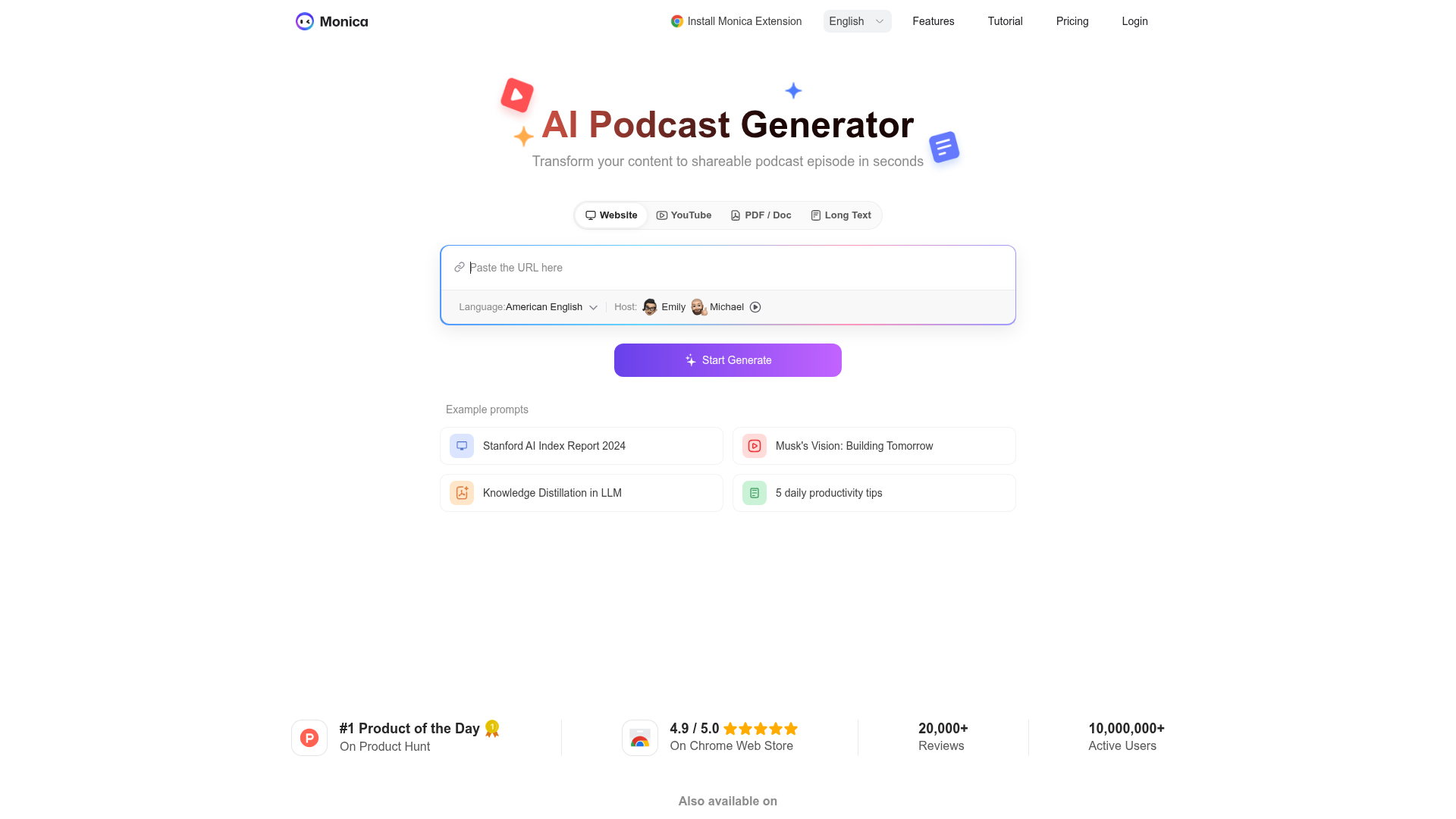
Monica focuses on converting websites, PDFs, YouTube videos, and long text into podcast-style audio. It is positioned as a fast way to make content more accessible and easier to consume on the go.
NoteGPT AI Podcast Generator
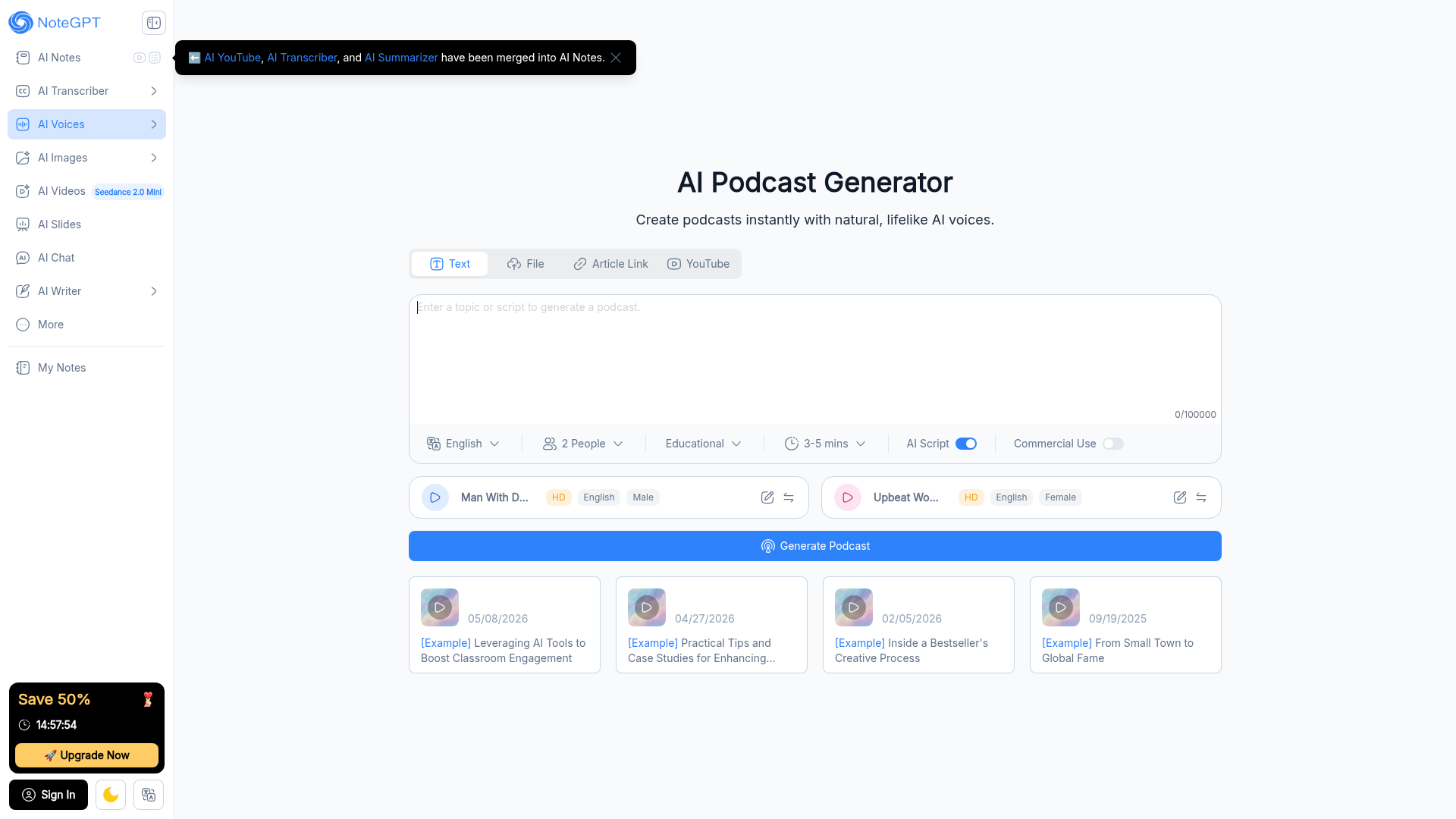
NoteGPT supports files, article links, YouTube inputs, multiple voices, and customizable podcast styles. It is useful for turning written or video content into a more listenable format.
Where CramAI fits differently
CramAI is not only about producing audio. It fits into the bigger learning workflow:
upload materials in multiple formats
generate personalized study plans
get source-anchored answers with traceability
link concepts across topics for deeper understanding
run dynamic assessments to find gaps
adapt study strategy in real time
reduce cognitive load by focusing on what matters most
support learners, educators, creators, and organizations at scale
That makes it especially useful for students who want more than a one-off audio study tool and need a complete exam-prep system.
Best Practices for Better AI Study Podcasts
Start from your own materials when possible
Your own notes, summaries, and emphasized lecture points are often more exam-relevant than generic source material.
Narrow the scope
One topic per episode beats one course per episode.
Use explicit prompts or structure
If your tool allows it, specify the output:
summarize only key theories
compare topic A and B
ask five revision questions
explain in plain language for exam review
Regenerate after cleanup
If the first version feels vague, the problem is often the source mix, not the tool.
Build follow-up actions
Every listening session should trigger one active step: quiz, notes, flashcards, or explanation.
Common Mistakes to Avoid
Turning everything into audio
Some subjects need diagrams, equations, annotations, or worked examples.
Listening without a goal
If you do not know what the episode is supposed to help you do, you will likely retain less.
Using raw, messy inputs
Bad inputs produce shallow outputs.
Mistaking familiarity for mastery
If it sounds familiar, test it anyway.
Skipping gap analysis
The smartest use of AI is not just summarizing what you uploaded. It is identifying what you still do not know and adjusting the plan accordingly.
Final Verdict
Turning your own materials into a study podcast is one of the most practical ways to reuse low-focus time without starting from scratch. It works especially well for chapter recaps, theory comparisons, concept reinforcement, and exam revision during commutes or routine activities.
But the real win is not passive listening alone. It is combining audio with active recall, source-linked review, mind maps, flashcards, quizzes, and practice exams. That is where CramAI stands out: it helps learners transform PDFs, notes, slides, web content, and media into a complete, adaptive study system rather than a single output.
If you want a smarter way to turn existing materials into personalized review content, identify what matters most, and study with more confidence, CramAI is a strong place to start.
FAQ
What AI can convert study material into podcasts?
Several tools can do this, including dedicated AI podcast generator platforms that accept notes, PDFs, websites, and videos. For learners who want more than audio alone, CramAI is especially useful because it connects podcast-style review with quizzes, summaries, source-linked answers, and adaptive study planning.
How to turn PDFs into AI made podcasts?
Start by uploading a clean, relevant PDF and choosing a narrow goal such as a chapter summary, theory comparison, or revision Q&A. The best results come when you pair the PDF to podcast output with active review, such as flashcards, short notes, or a quiz afterward.
How much does a podcast with 10,000 listeners make?
It depends on the monetization model, ad rates, sponsorships, and audience niche, so there is no single fixed number. In the context of this article, the main goal is not podcast revenue but using personalized audio to support learning and exam preparation.
Can you create an AI podcast?
Yes. You can create an AI podcast from notes, slides, PDFs, articles, or study guides and turn them into chapter summaries, concept explanations, or revision episodes. The most effective approach is to use audio as part of a wider study system rather than relying on listening alone.
Can ChatGPT make a podcast?
ChatGPT can help write the script, structure a summary, create Q&A prompts, or simplify complex topics for audio. To produce a finished podcast with voices and playback, you typically need a separate tool or platform that turns that script into podcast-style audio.
How much does a podcast with 1000 listeners make?
Income varies widely based on format, ads, sponsors, affiliate offers, and niche value, so earnings may be small or inconsistent at that level. For students and educators, the more relevant value is how an AI learning podcast can make commutes and low-focus time more useful for review.